

Blog
Ashwagandha for Sleep vs. Ashwagandha for Stress: Same Herb, Different Routine

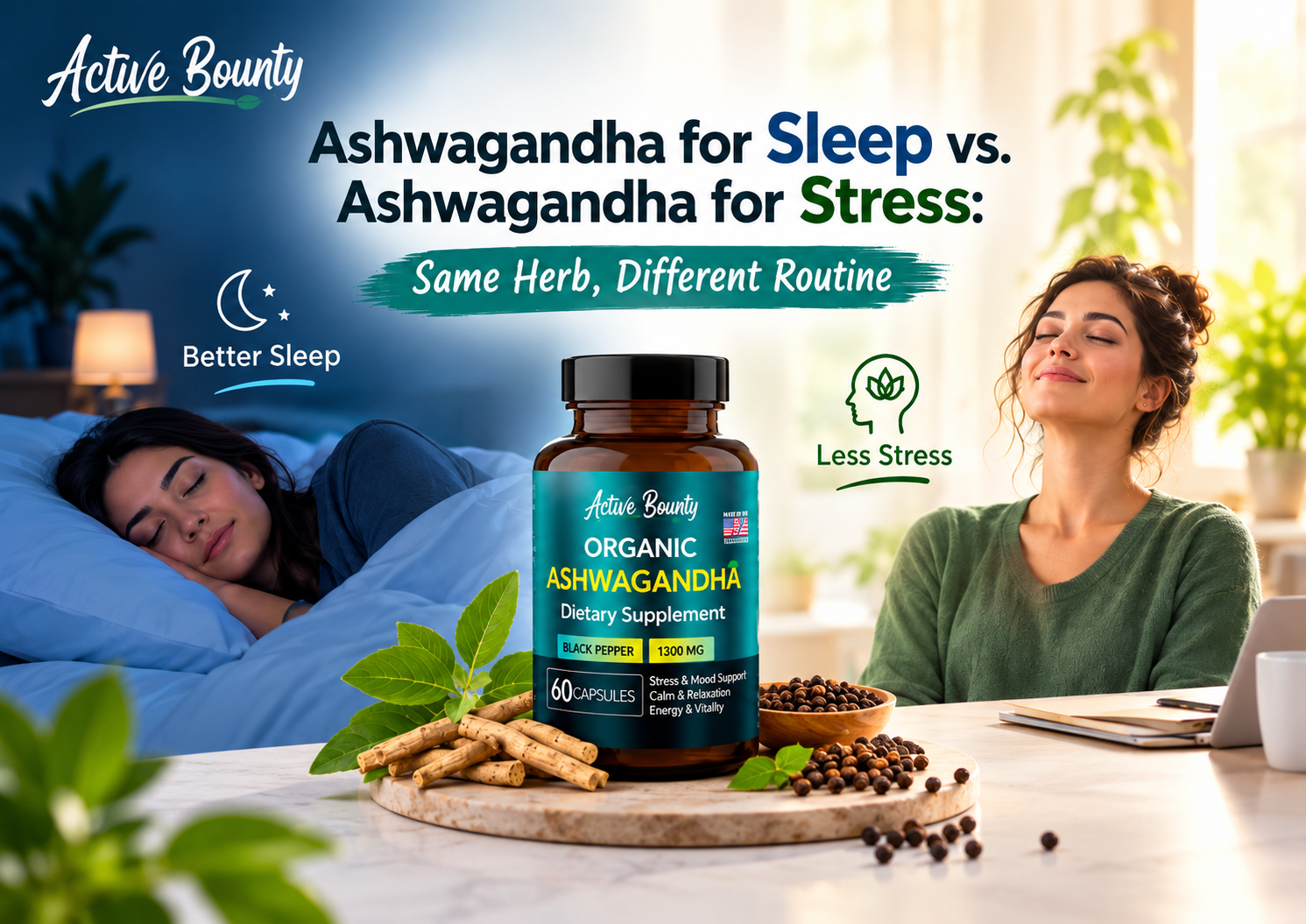
Ashwagandha for Sleep vs. Ashwagandha for Stress: Same Herb, Different Routine
Most people buy ashwagandha for one of two reasons. Either the day feels too loud — racing thoughts, a tight chest before meetings, that wired-but-drained feeling by 4pm — or the night does, when the body is exhausted but the mind refuses to switch off.
Here is the part almost nobody explains at the point of purchase: it is the same herb for both. What changes is the routine. The timing, the dose split, what you take it with, and what you pair it with in the rest of your day.
Understanding that difference is usually what separates people who say "ashwagandha did nothing for me" from people who quietly restock every month.
What ashwagandha actually is (the 60-second version)
Ashwagandha (Withania somnifera), sometimes called Indian ginseng or winter cherry, is an adaptogenic herb used in Ayurveda for centuries. An adaptogen is a plant compound that helps the body adapt to stress rather than forcing a single fixed response — which is exactly why one herb can support both alert calm during the day and easier wind-down at night.
The active compounds are withanolides, naturally occurring steroidal lactones concentrated in the root. The species name somnifera literally translates as "sleep-inducing," which tells you something about how this plant has been used historically.
Two things determine whether an ashwagandha supplement does much of anything:
- Which part of the plant it comes from. Whole root extract has the longest traditional and clinical track record. Cheaper root-and-leaf blends inflate the withanolide percentage on the label using leaf material, which is a different compound profile altogether.
- Whether your body absorbs it. Withanolides are fat-soluble and poorly absorbed on their own. This is why quality formulas — including our Organic Ashwagandha 1300mg with Black Pepper Extract — include piperine from black pepper, which meaningfully improves bioavailability.
A 1300mg whole root dose with an absorption enhancer behaves very differently from a 300mg proprietary blend with no delivery support. If a previous bottle disappointed you, the formula is the first place to look, not the herb. For a deeper breakdown of what to look for on a label, see our guide on what organic ashwagandha actually is and how to choose it.
It also helps to know how ashwagandha compares to the other two pillars of a wellness stack. If you are still deciding where to start, our comparison of NAD+ vs. Ashwagandha vs. Nerve Support breaks down which one matches your main complaint.
How ashwagandha supports stress: the daytime routine
When you are under sustained pressure, the HPA axis (hypothalamic-pituitary-adrenal) keeps cortisol elevated well past the point of usefulness. Cortisol is not the villain — you need a healthy morning cortisol rise to feel awake and motivated. The problem is the flat, dragging, chronically elevated curve that comes from months of deadlines, caregiving, poor sleep and skipped meals.
Ashwagandha is studied largely as a cortisol support supplement, and users typically describe the daytime effect not as sedation but as a longer fuse. The same traffic jam, the same inbox, less of a physical reaction to it.
The stress routine looks like this:
| Element | Stress-Support Routine |
|---|---|
| When | Morning, with breakfast |
| Why then | Aligns with your natural cortisol peak and supports a steadier curve through the working day |
| Take it with | Food containing some fat — eggs, yoghurt, avocado, nuts. Withanolides are fat-soluble |
| What to expect | Subtle. Week 1–2 is often nothing obvious. Weeks 3–6 is where most people notice they are reacting differently |
| Pair with | Ten minutes of morning daylight, protein at breakfast, and caffeine after food rather than before |
If you are taking ashwagandha for stress and mood support, consistency beats dose size every single time. A daily 1300mg taken for eight weeks will outperform a sporadic double dose taken whenever you remember.
One practical note: some people find daytime ashwagandha slightly softens their edge — a good thing before a difficult conversation, less ideal thirty minutes before a heavy squat session or a high-stakes pitch. If that is you, shift the dose to the evening and read on.
This daytime cortisol-support use case is a large part of why demand has climbed so sharply. We cover the broader picture in why ashwagandha is one of the fastest-growing supplements in 2026.
How ashwagandha supports sleep: the nighttime routine
The sleep use case is not the same as a sedative. Ashwagandha will not knock you out the way a sleep drug does, and if that is what you are expecting you will be disappointed.
What it appears to support is sleep onset latency — the gap between lying down and actually falling asleep — and subjective sleep quality. In plain terms: less lying there rehearsing tomorrow, and a night that feels more restorative even at the same duration. It helps most with the specific problem of stress-driven poor sleep, where the body is tired but the nervous system is still running.
The sleep routine looks like this:
| Element | Sleep-Support Routine |
|---|---|
| When | 60–90 minutes before bed |
| Why then | Gives absorption time to line up with your natural wind-down window |
| Take it with | A small snack containing fat — a handful of almonds, a spoon of nut butter, or warm milk in the traditional Ayurvedic preparation |
| What to expect | Falling asleep more easily rather than sleeping longer. Improvements in perceived morning restedness usually build over 4–8 weeks |
| Pair with | Magnesium glycinate, a cooler room, screens down 45 minutes before, no caffeine after 2pm |
If early-evening tension is your trigger — that 6pm crash where the day catches up with you — taking your dose at dinner rather than bedtime often works better than either standard option.
If poor sleep is paired with restless legs, tingling, or discomfort that flares up at night, the root cause may not be stress at all. Our article on whether that 'normal' tingling is actually a warning sign is worth reading alongside this one.
Morning vs. night: which should you choose?
Use this quick decision guide.
Take ashwagandha in the morning if:
- Your main complaint is daytime anxiety, irritability or feeling overwhelmed
- You want steadier energy and focus across the working day
- You sleep reasonably well already
- You are using it alongside training for stamina and recovery support
Take ashwagandha at night if:
- You fall asleep slowly because your mind will not stop
- You wake at 3am with your to-do list running
- Daytime doses make you feel a little too relaxed or flat
- Your stress is mostly evening-loaded
Split the dose if: you have both problems. Many people do best with half in the morning and half in the evening, which keeps levels steadier across 24 hours. With a 1300mg once-daily formula, an easier version of this is alternating your focus: take it consistently at night for the first month, and reassess.
There is no wrong answer here, and no risk in experimenting. Give any routine a minimum of three to four weeks before you judge it, and change only one variable at a time.
How long until ashwagandha works?
Expectations are where most people go wrong, so let's be direct.
Days 1–7
Usually nothing dramatic. Some people report slightly easier evenings within the first week.
Weeks 2–4
The most common window for noticing changes in stress reactivity and sleep onset.
Weeks 6–12
Where the research typically measures its clearest outcomes. This is the real evaluation point.
Ashwagandha is a build supplement, not a switch supplement. Treat it like strength training rather than a painkiller.
Who should be cautious
Ashwagandha is generally well tolerated, but it is not for everyone. Speak to your doctor before starting if you are pregnant or breastfeeding, have a thyroid condition or take thyroid medication, have an autoimmune condition, take sedatives, immunosuppressants or blood sugar medication, or have a scheduled surgery within two weeks. Some people experience mild digestive upset, which usually resolves by taking it with a fuller meal. Nightshade sensitivity is worth flagging to your practitioner, since Withania somnifera belongs to that family.
Choosing an ashwagandha supplement that will actually do something
Before you buy any bottle, check for these five things:
- Whole root, not root-and-leaf. Ask what part of the plant the extract comes from.
- A meaningful dose. 1300mg of organic whole root per serving, not a 300mg sprinkle inside a proprietary blend.
- An absorption enhancer. Black pepper extract (piperine) is the simplest and most proven.
- Certified organic sourcing. Ashwagandha is a root crop, and roots concentrate whatever is in the soil.
- Transparent labelling. If the amount of each ingredient is hidden behind the words "proprietary blend," you cannot verify the dose you are paying for.
Active Bounty Organic Ashwagandha 1300mg with Black Pepper was built against exactly that checklist: USDA organic whole root ashwagandha, a full 1300mg per serving, piperine from black pepper for enhanced absorption, one capsule a day, vegan, non-GMO and made in the USA. It works equally well as a morning routine for stress and mood support or an evening routine for calm and relaxation — the bottle does not change, only the hour you take it.
If your stress and sleep issues sit alongside low daytime energy, it also stacks cleanly with a NAD+ formula in the morning. Our guide on building a daily supplement stack with NAD+, Ashwagandha, and Nerve Support covers how to combine all three without overlap, and the best time of day to take NAD+, Ashwagandha, and Nerve Support goes deeper into scheduling doses across a full day.
Frequently asked questions
Related reading
Find your routine
Whether you are chasing calmer days or quieter nights, the right ashwagandha routine starts with a formula worth being consistent with.
These statements have not been evaluated by the Food and Drug Administration. This product is not intended to diagnose, treat, cure or prevent any disease. This article is for informational purposes only and is not a substitute for medical advice. Consult a qualified healthcare professional before starting any new supplement, particularly if you are pregnant, nursing, taking medication or managing a health condition.