

Blog
Why Ashwagandha Is One of the Fastest-Growing Supplements in 2026

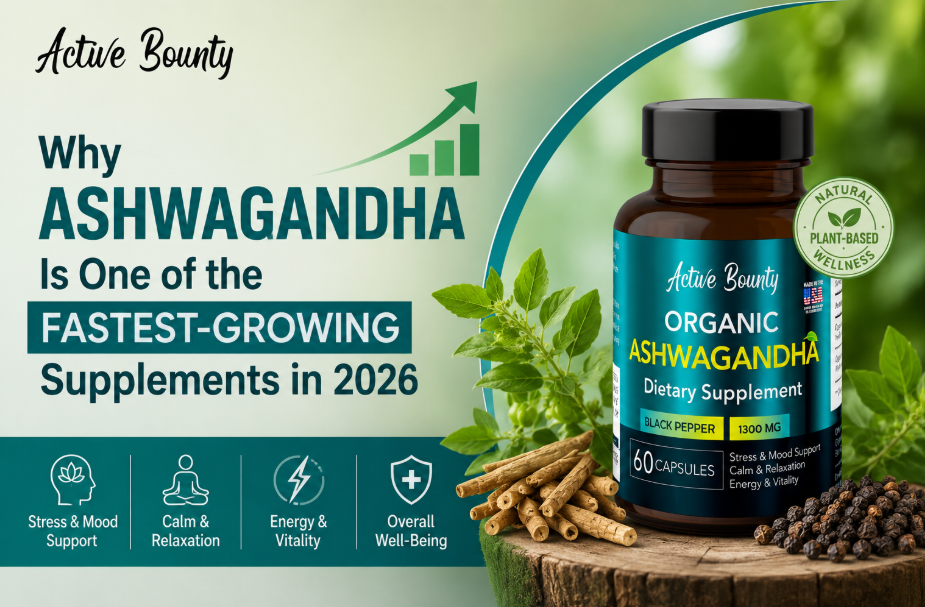
Why Ashwagandha Is One of the Fastest-Growing Supplements in 2026
A few years ago, ashwagandha was a niche ingredient mostly known within Ayurvedic and herbal medicine circles. Today, it's one of the fastest-growing names in mainstream wellness — and the numbers back that up. Ashwagandha sales grew 27% in mainstream retail channels to reach $176 million, and it was already the third-most-purchased herbal supplement in the US the year before, at $144 million in sales. That's not a passing trend; that's an ingredient earning its place as a genuine category leader. This post breaks down exactly why ashwagandha's popularity keeps climbing, what the research actually shows, and what to look for if you're considering adding it to your own routine.
What Is Ashwagandha, and Why Is Everyone Talking About It?
Ashwagandha (Withania somnifera) is a botanical rooted in Ayurvedic medicine, classified as an adaptogen — a category of compounds traditionally used to help the body respond to and manage everyday stress. Unlike stimulants or sedatives, adaptogens are generally understood to work by helping regulate the body's stress response rather than forcing a specific effect, which is part of why ashwagandha has resonated so strongly with a wellness market increasingly focused on sustainable, non-habit-forming stress support.
The ingredient isn't new — it's been used for centuries — but modern clinical research is now catching up to traditional use, and that's a big part of what's fueling its current growth.
The Research Behind the Growth
This isn't just a marketing trend — the science has genuinely strengthened in recent years, and that credibility is a major reason ashwagandha has moved from niche supplement to mainstream staple.
Cortisol and stress reduction
Clinical studies show measurable results: one meta-analysis found ashwagandha supplementation significantly reduced cortisol levels alongside meaningful drops in both the Perceived Stress Scale and the Hamilton Anxiety Rating Scale after eight weeks of use. Other research has shown cortisol reductions of up to 28–30% with consistent supplementation.
Sleep quality
Multiple studies link ashwagandha use to improved sleep quality, which makes sense given its role in supporting a more regulated stress response — poor sleep and elevated stress hormones are closely connected.
Athletic performance and recovery
A growing body of research, including systematic reviews covering thousands of participants, suggests ashwagandha supplementation may support endurance, muscular strength, and recovery — a newer research direction that's helping the ingredient reach an entirely different audience: athletes and active individuals, not just people seeking stress relief.
Safety profile
Larger studies, including one covering 145 healthy adults at doses up to 2,000 mg/day over 12 weeks, found no clinically significant changes in liver, kidney, thyroid, lipid, or blood sugar markers — with mild nausea being the only notable side effect, and only in a small percentage of participants. That kind of safety data across large-scale, long-term, and high-dose use is exactly what gives both consumers and formulators confidence in the ingredient.
Why Ashwagandha's Popularity Keeps Climbing
A few forces are converging at once:
- Stress is a universal, everyday problem. Unlike more niche supplement categories, ashwagandha addresses something almost everyone deals with, which naturally widens its potential audience.
- The clinical research has matured. A decade ago, most evidence was preliminary. Now there are systematic reviews, meta-analyses, and large safety trials — the kind of evidence that builds real consumer trust.
- It's expanding beyond capsules. Ashwagandha is now formulated into gummies, drinks, bars, and more — though a well-dosed capsule formula remains the most reliable way to get a consistent, clinically relevant amount per serving.
- It fits the "non-stimulant wellness" moment. As more people look to reduce reliance on caffeine and stimulant-based energy products, adaptogens like ashwagandha offer an alternative that works with the body's stress response instead of overriding it.
What to Look for in an Ashwagandha Supplement
Not every ashwagandha product on the market is built the same way. Before choosing one, check for:
- A clinically relevant dose. Most research showing meaningful stress and cortisol benefits uses doses in the 300–600 mg range, with some studies going as high as 1,000–2,000 mg daily.
- A standardized extract. Look for a specified withanolide percentage rather than a vague "ashwagandha root powder" listing — withanolides are the compound class most closely tied to the ingredient's studied effects.
- An absorption enhancer. Ashwagandha's active compounds aren't always easy for the body to absorb efficiently on their own, which is why formulas paired with black pepper extract (BioPerine) are worth prioritizing — the combination is specifically designed to improve bioavailability.
- Third-party testing and GMP certification. As with any supplement, manufacturing standards matter as much as the ingredient itself.
Where This Leaves You
Given how strong the growth and research trajectory both are, ashwagandha isn't a trend likely to fade soon — it's increasingly treated as a foundational, evidence-backed addition to a daily wellness routine, in much the same category as a multivitamin or omega-3. If you're considering adding it to your own routine, Active Bounty's Ashwagandha with Black Pepper formula checks each of the boxes above — a meaningful 1300mg dose, paired with black pepper extract for enhanced absorption, made in an FDA-registered, GMP-certified facility.
It also pairs naturally with the rest of a broader wellness routine — many people combine stress support with cellular energy support or nerve health support, depending on their specific goals. You can browse the full lineup on the shop page to see which combination fits your routine best.
Frequently Asked Questions
This article is for informational purposes only and is not intended as medical advice. Supplements are not intended to diagnose, treat, cure, or prevent any disease. Consult your healthcare provider before starting any new supplement, especially if you are pregnant, nursing, or taking medication.