

Blog
How Long Does It Take for Nerve Support Supplements to Work?

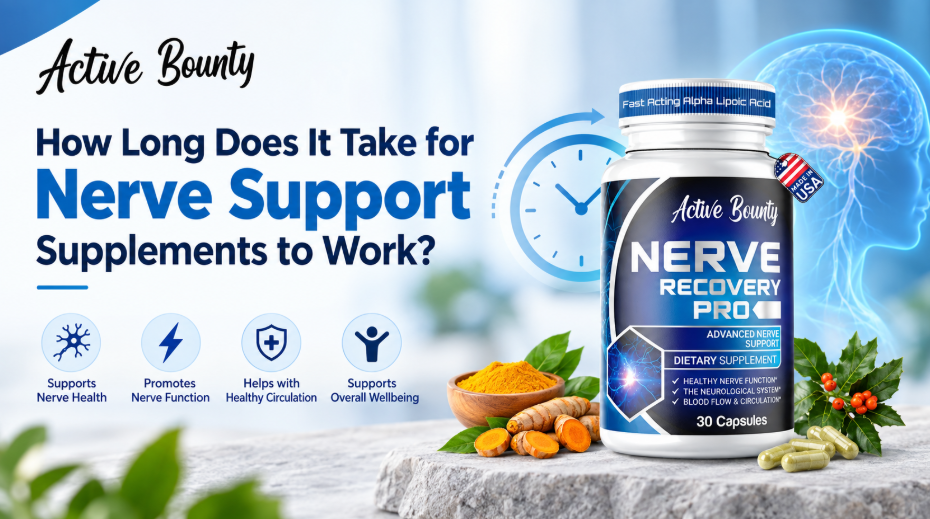
How Long Does It Take for Nerve Support Supplements to Work?
A realistic, week-by-week look at nerve support supplement timelines — what to expect, which ingredients matter, and how to tell the difference between "not working yet" and "not working."
Quick answer: Most people notice early changes — calmer nerve sensations, steadier sleep — within 2 to 4 weeks of daily use. Noticeable improvement in tingling, numbness, or discomfort usually builds over 8 to 12 weeks, since nerve tissue repairs gradually. Full benefits are typically reported around the 3-month mark of consistent use, not overnight.
If you've just started a nerve support supplement, you've probably searched some version of "why isn't this working yet." It's one of the most common questions in nerve health, and it's a fair one — supplement marketing rarely explains the actual biology of nerve repair, or how long that process realistically takes.
The honest answer is that nerve support supplements aren't fast-acting the way a painkiller is. They work by feeding a slow, ongoing repair process: rebuilding the protective myelin sheath around nerve fibers, calming oxidative stress, and restoring nutrients that damaged nerves need to function properly. That process runs on a biological clock, not a marketing one. Below is what that clock actually looks like, ingredient by ingredient and week by week.
How nerve support supplements actually work
Nerve support formulas aren't a single ingredient — they're usually a combination of B-complex vitamins, antioxidants like alpha lipoic acid, and adaptogenic herbs such as ashwagandha, each targeting a different part of nerve health:
- Nutrient repletion — B1, B6, and B12 are directly involved in maintaining the myelin sheath, the insulating layer that lets nerve signals travel cleanly. Deficiency in any of these is strongly linked to tingling, numbness, and nerve pain.
- Antioxidant protection — Ingredients like alpha lipoic acid (ALA) reduce oxidative stress on nerve cells, which is a major driver of nerve damage in conditions like diabetic neuropathy.
- Stress and cortisol regulation — Chronic stress and elevated cortisol can worsen nerve sensitivity. Adaptogens such as organic ashwagandha work indirectly, calming the nervous system's stress response over time.
None of these mechanisms happen instantly. Nutrient stores need to be rebuilt, damaged nerve fibers regenerate at roughly one millimeter per day, and the nervous system needs sustained, not occasional, support.
The realistic nerve support supplement timeline
Here's a general timeline based on how these ingredients behave in the body. Individual results vary depending on the severity of nerve symptoms and how consistently the supplement is taken.
Week 1–2
Nutrient levels begin to rebuild. Some people notice subtly better sleep or a slightly calmer nervous system, but nerve sensations themselves usually haven't shifted yet. This stage is about foundation, not results.
Week 3–6
This is when most people report the first real signs of change — slightly less intense tingling, fewer "pins and needles" episodes, or steadier energy. Antioxidant ingredients like ALA are typically reaching more stable levels in the body.
Month 2–3
Cumulative repair becomes more noticeable. Numbness and discomfort tend to feel less frequent or less intense day-to-day, and many users describe this window as when the supplement "starts to feel worth it."
3+ months
This is generally where full benefits show up, and where consistent users report the most stable, lasting improvement. Nerve support works best as a long-term daily habit rather than a short course.
What affects how fast you'll notice results
Two people can take the same supplement and have very different experiences. These are the biggest variables:
- Severity and duration of nerve symptoms — Mild, recent tingling tends to respond faster than long-standing numbness or chronic neuropathy.
- Consistency — Skipping doses resets the nutrient-building process. Daily use, at the same time each day, drives faster, more reliable results.
- Underlying cause — Nerve symptoms linked to a nutrient deficiency often improve faster than those tied to uncontrolled blood sugar, alcohol use, or an underlying medical condition.
- Formulation and dosage — Not all "nerve support" labels use clinically meaningful doses of B12, ALA, or benfotiamine. Under-dosed formulas take longer to show any effect at all, if they do — see our guide on what to look for in a nerve support supplement before you buy.
- Absorption — Taking supplements with food, and choosing bioavailable forms (like methylcobalamin over cheaper B12 forms), affects how much of the ingredient your body actually uses.
- Lifestyle factors — Blood sugar control, alcohol intake, sleep quality, and diet all influence how quickly nerves can repair, regardless of supplementation.
Ingredient-by-ingredient: what to expect from each
Alpha Lipoic Acid (ALA)
An antioxidant widely studied for nerve-related discomfort; early changes in tingling or burning sensations are often the first thing people notice.
Methylcobalamin (B12)
The active form of B12 used directly by nerve cells; rebuilding depleted stores and supporting myelin takes longer than a quick energy boost.
Benfotiamine (B1)
A fat-soluble form of vitamin B1 studied for nerve health, particularly where blood sugar is a factor; effects build gradually with daily use.
Ashwagandha
Works on the stress-cortisol axis rather than nerves directly; many people notice calmer stress responses before they notice physical nerve changes. Read more on why ashwagandha use is growing so fast.
Signs your nerve support supplement is working
Because change is gradual, it helps to know what "working" actually looks like in the early stages:
- Tingling or "pins and needles" episodes feel less intense, even if they haven't fully stopped
- Numb areas feel slightly more sensitive or responsive than before
- Sleep is less disrupted by nerve discomfort
- Overall energy and mood feel steadier, a sign the stress-support ingredients are working
- Symptoms feel more manageable day-to-day, even without being fully gone
Getting the most out of a nerve support routine
Consistency does more for results than dosage-chasing. A few habits make a measurable difference: take your supplement at the same time each day, pair it with a meal for better absorption, keep blood sugar and alcohol intake in check, and commit to at least 8–12 weeks before evaluating whether it's working.
If you're taking more than one supplement, it also helps to see how they fit together — our guide to building a daily supplement stack covers timing NAD+, ashwagandha, and nerve support around each other.
Active Bounty's Nerve Support formula is built around clinically studied forms and doses of alpha lipoic acid, benfotiamine, and methylcobalamin, so the ingredients are doing the part of the work that's within a supplement's control. The rest — consistency and time — is where results actually get made.
When to see a doctor instead of waiting it out
Nerve support supplements are meant to complement, not replace, medical care. Check in with a healthcare provider if you experience any of the following:
- Numbness, tingling, or weakness that is getting worse rather than improving
- Sudden onset of nerve symptoms, especially on one side of the body
- Nerve pain accompanied by unexplained weight loss, fever, or vision changes
- No noticeable change at all after 3 full months of consistent use
- Existing diabetes, autoimmune conditions, or prescription medications that could interact with supplements
Related reading
Frequently asked questions
Nerve support isn't a quick fix, and any product that promises one is worth being skeptical of. If you're still deciding where nerve support fits alongside other supplements, our comparison of NAD+, ashwagandha, and nerve support is a good next read. What it can offer, with consistent use over 8 to 12 weeks and beyond, is steady, cumulative support for a repair process your body is already trying to carry out. Give the timeline the time it needs, track how you feel week to week rather than day to day, and use the checklist above to know what real progress actually looks like.
This article is for general educational purposes and is not medical advice. Individual results vary. Talk to a healthcare provider before starting any new supplement, especially if you have an existing health condition, are pregnant or nursing, or take prescription medication. These statements have not been evaluated by the FDA. This product is not intended to diagnose, treat, cure, or prevent any disease.